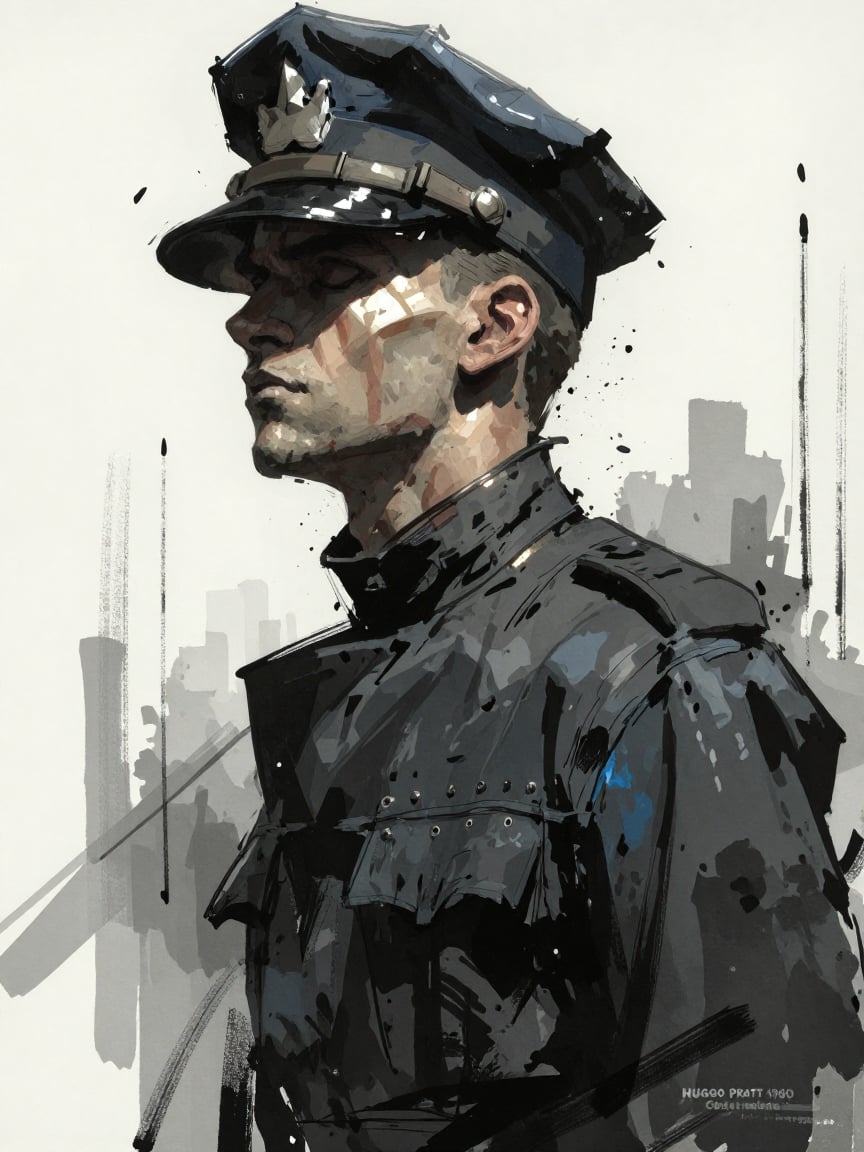
Bradhamel art style. In this arresting cinematic portrait, we are drawn into an intimate, shadow-laced moment of stillness , a lone figure turned away from us, his profile etched against stark white space like a silhouette carved by fate. He wears a crisp officer’s cap with a subtle emblem glinting atop its brim, while thick, dark uniform folds cascade around him in dramatic, ink-blotted strokes that suggest both authority and weariness. His face is rendered in warm ochre tones, contrasted sharply with deep blacks and cool blues bleeding through the fabric; eyes closed or gazing downward, he exudes quiet resolve, or perhaps sorrow, his posture rigid yet weary. The light seems to come not from above but from within: a soft glow illuminates his cheekbone and temple, casting long shadows across his neck and collar, enhancing the sense of isolation. This isn’t photorealism, it's bold, expressive watercolor meets ink wash, layered with texture and movement reminiscent of film noir sketches, where every brushstroke feels deliberate, almost theatrical. The composition isolates him entirely, a silent sentinel suspended between duty and contemplation, with no background, only breathless atmosphere surrounding him. A small signature “HUGO PRATT 1980” at lower right anchors it as artifice, while beneath it, tiny text whispers dedication to Corte Maltese, an homage steeped in mystery. Mood? Haunting reverence lingers, the man exists on the edge of action, frozen mid-thought, bathed in monochrome drama, evoking the weight of legacy carried silently under heavy shoulders.