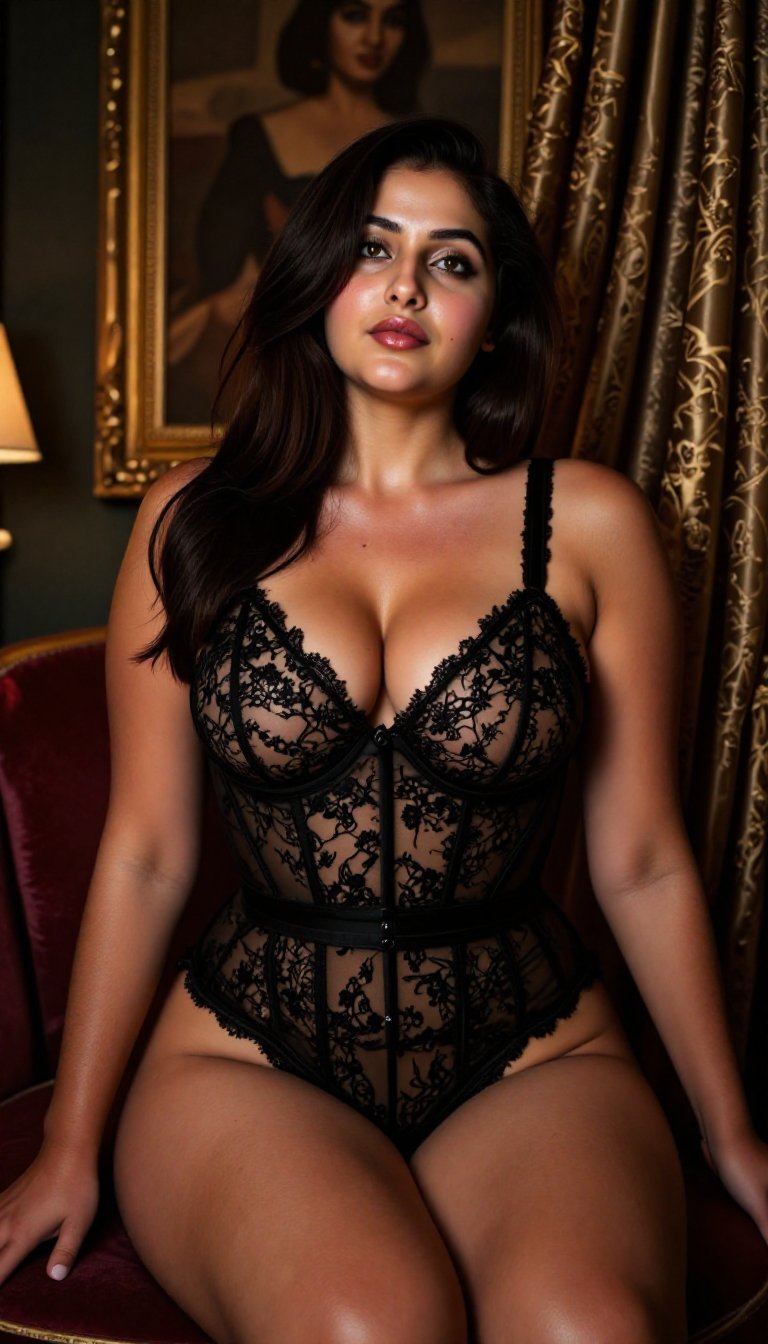
Film Noir Glamour Portrait — In the Style of Annie Leibovitz — Featuring Parisa
— A velvet-draped reverie where shadow and silk entwine, and Parisa doesn’t just recline — she rules the room. The lace is her armor. The light? Her coronation.
Subject: Parisa — The Velvet Sovereign
She is Parisa, tall (5’10”), statuesque, her body a living sculpture carved by chiaroscuro — huge breasts gently cradled in intricate black lace, narrow waist hinted at by the corset’s silhouette, wide hips subtly suggested by her seated posture, round buttocks grounded in the plushness of velvet, toned arms resting with quiet authority.
Her very long, straight dark brown hair — nearly black — cascades over one shoulder, soft waves catching the amber glow of ambient light like liquid obsidian. Her amber-brown almond eyes gaze upward — not seductive, but sovereign, holding centuries of poetry in their depth. That distinct beauty mark under the left side of her lower lip? Now a subtle anchor beneath soft, matte rose lipstick — a silent declaration of elegance, mystery, and control.
She wears a hand-crafted black lace bustier, its delicate floral patterns tracing the curve of her bust and waist like a second skin. The front features a subtle zipper, hinting at restraint rather than exposure — the fabric clings with architectural precision, celebrating form without revealing all. No cleavage exposed — only implied, sculpted by shadow and silhouette.
Her pose is poised, intimate: she leans back against a heavy brocade curtain, one arm draped along the edge of an antique gilded frame behind her, the other resting lightly on her thigh. Her head tilts slightly, chin lifted, lips parted as if mid-breath — not whispering, but commanding. Her expression? Calm. Confident. Unshaken. As if she has reclined here since the days of candlelit salons, watching empires rise and fall, knowing she outlasts them all.
Setting: Noir Elegance — A Room Where Time Stands Still
The scene is steeped in classic film noir opulence: dimly lit, moody, cinematic. Behind her, a large gilded painting — blurred, indistinct — hangs on the wall, its subject lost to time, its presence adding weight to the atmosphere. To her right, a heavy damask curtain falls in soft folds, its ornate pattern echoing the lace of her bodice. The lighting is masterfully controlled — high-contrast chiaroscuro, with deep shadows and luminous highlights that emphasize texture: the sheen of her skin, the weave of the lace, the gloss of her lips.
Annie Leibovitz would have shot this using practical lighting — a single lamp off-frame casting warm amber tones across her face and chest, augmented by hidden reflectors to sculpt her form without crossing into explicit territory. The shallow depth of field keeps her razor-sharp while letting the background dissolve into atmospheric abstraction.