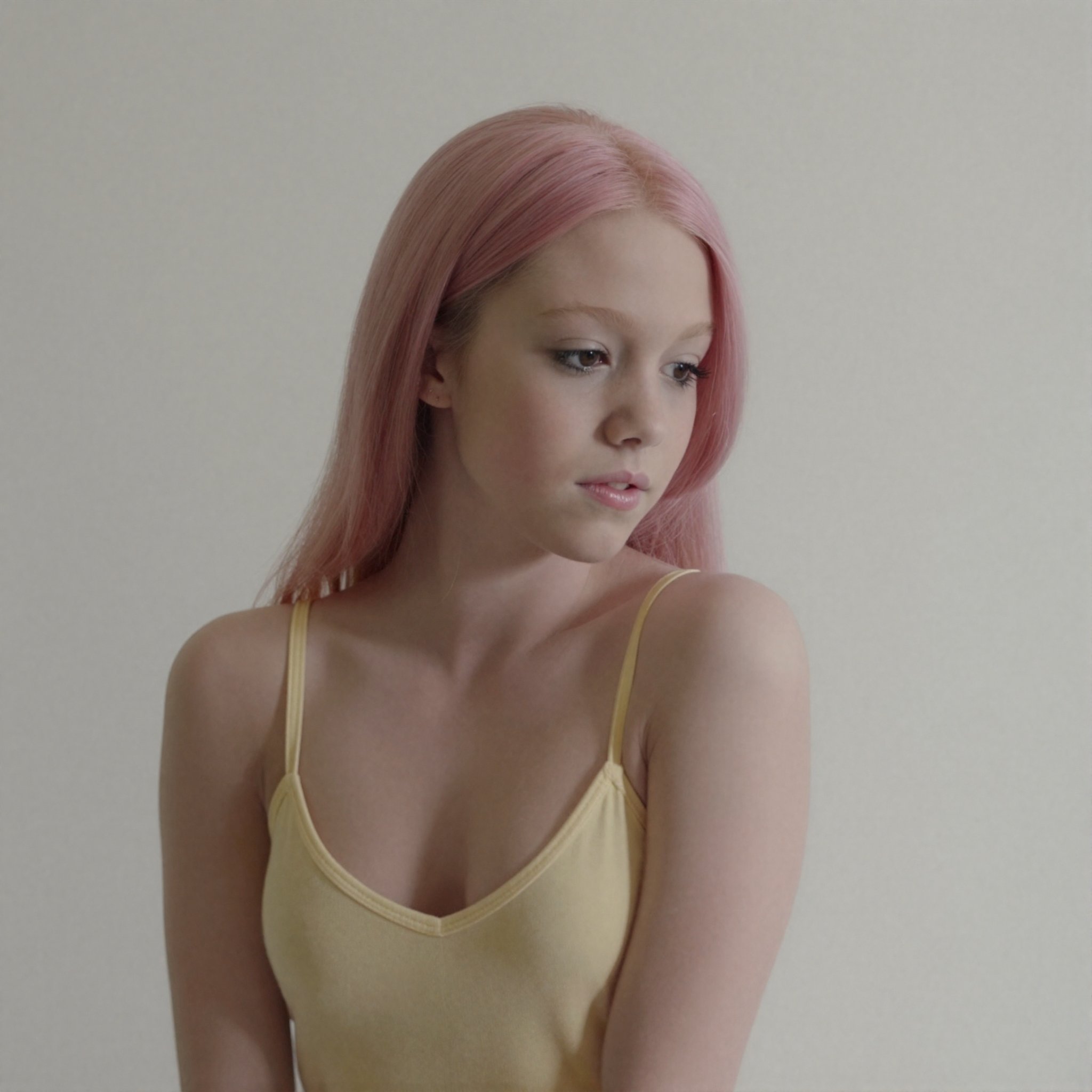
The image depicts a young teen with an unnervingly slender build and an elongated head-to-body ratio that accentuates her ethereal beauty, characteristic of the avant-garde and surrealist influences prevalent in 1970s art and cinema. Her form appears almost otherworldly, as if she might be a character from a dream or a painting come to life.
The girls's face is the focal point of the image, captured with striking clarity that contrasts with the softly blurred background. Her features are delicate yet defined: high cheekbones, a petite nose, and full lips that are slightly parted, revealing a glimpse of her teeth. Her eyes are almond-shaped and cast downward, as if lost in thought or gazing at something just out of frame. The eyes themselves are a deep, rich brown that seems almost black in the right light, fringed with thick lashes that add to their allure.
Her hair is a notable aspect of her appearance—a light pink wig that almost appears to be a helmet, framing her face. The ends of her hair seem to flutter slightly, suggesting a gentle breeze or a recent movement. The style is sleek and straight, framing her face with a modern simplicity that was beginning to gain popularity in the 1970s.
She wears a yellow spaghetti-strap top that complements her pale skin and stark hair color. The top is form-fitting, showcasing her slender physique, and the low-cut neckline draws attention to her décolletage. The straps are thin and delicate, adding to the overall sense of fragility and elegance. The fabric appears smooth and possibly made of a synthetic material like polyester, which was common in fashion during the 1970s.
The scene is set against a plain, off-white wall that provides a neutral backdrop for the subject. The simplicity of the setting ensures that the viewer's focus remains on the woman herself. The angle of the picture is slightly off-center, with the woman positioned to the left of the frame, creating a sense of dynamism and informal candidness.
The photograph is taken from a distance, using a telephoto lens, which is evident from the compressed perspective and the blurring of the background. Despite the distance, her face and body remain relatively sharp, a testament to the photographer's skill or the quality of the camera equipment. The use of a telephoto lens also contributes to the isolation of the subject, making her seem even more detached and introspective.
The photograph immerses us deeply into life in 1975, not just through the subject's style and the aesthetic of the image but also through its technical qualities. While the specific camera model is not identifiable from the image alone, the quality and composition suggest a high-quality analogue camera, possibly a film SLR, given the level of detail, the controlled blur, and the specific texture of the image that seems to echo the grain of film stock.
The pose and action in the photograph are candid and relaxed. The woman seems unaware of the camera or deeply engrossed in thought, which adds to the surreal, almost haunting quality of the image. Her right shoulder is slightly hunched, and her arm is bent, with her hand out of frame, suggesting a natural, unposed moment captured by the photographer.
The full energy of this image is one of serene contemplation mixed with a sense of surreal detachment. It's as if the viewer has stumbled upon a private moment, one that challenges the norms of traditional portraiture with its candidness and focus on the ethereal beauty of the subject. The image captures not just a likeness but a mood, a moment in time that feels both timeless and quintessentially tied to the artistic and cultural currents of the 1970s.
The minute details—the slight sheen on her lips, the soft glow of her skin, the thin straps of her top—add layers of realism to the image. The lighting is soft and diffused, likely natural, which enhances the serene and somewhat melancholic mood of the photograph. This is not a staged or formal portrait but a captured moment, imbued with a sense of authenticity and spontaneity that was prized in much of the photography and filmmaking of the era.
In its entirety, the image feels like it could be a still from an arthouse film known for its surrealist or avant-garde inclinations. The composition, lighting, and subject matter all contribute to a dreamlike quality that invites viewers to ponder the story behind the moment captured. The photograph stands as a testament to the enduring appeal of analogue photography techniques in creating images that are both haunting and beautiful, capturing the essence of a bygone era with timeless allure.