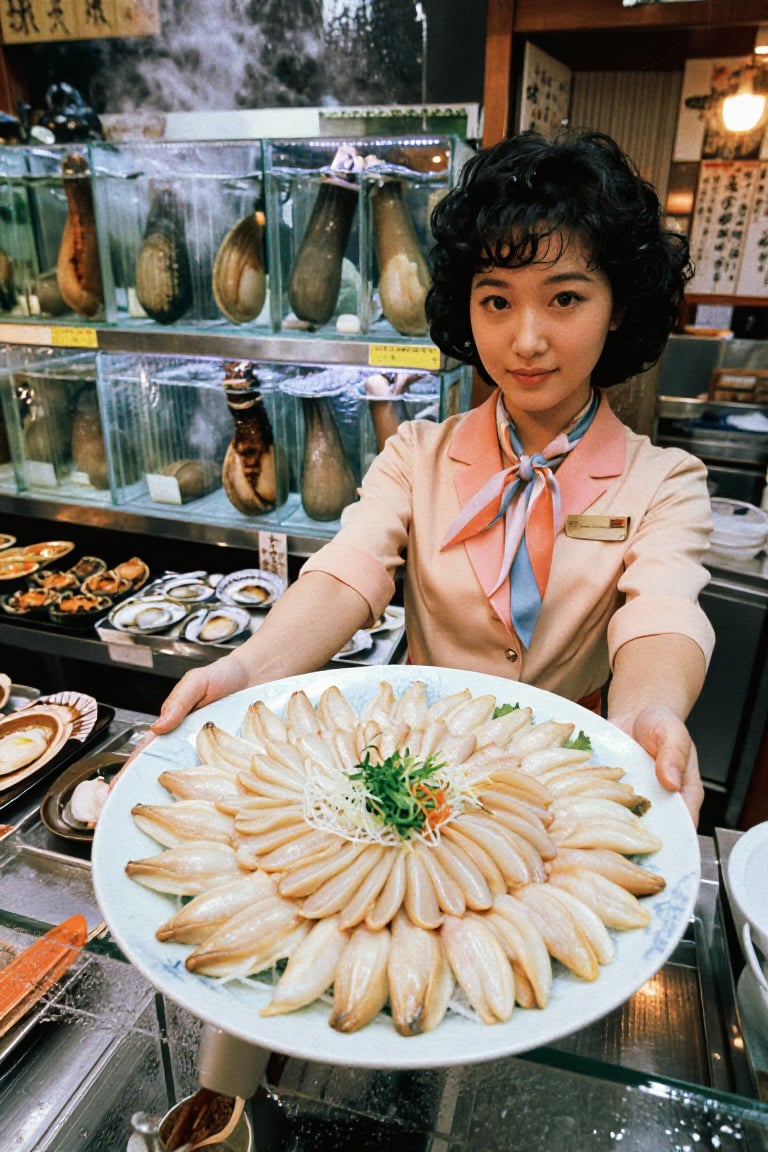
East Asian girl seafood counter clerk inside a Showa-era Japanese seafood specialty shop, medium close-up across a glass seafood counter, delicate refined face with subtle classic makeup, glossy black hair in a soft curled bob haircut, elegant slender curvy figure with an extremely tiny waist. Wearing a fitted pastel-toned uniform jacket, ribbon scarf, and name tag.
She is gracefully holding a luxurious serving plate with both hands toward the camera.
On the plate is a realistically proportioned geoduck sashimi (象拔蚌刺身) based on real biological dimensions. The full geoduck species typically measures 60 to 100 cm including siphon, while the edible sashimi portion used here is an 18 to 25 cm segment of the siphon only. The sashimi is sliced into ultra-thin 2 to 4 mm cuts, each slice measuring 6 to 8 cm in elongated oval strips. The plate is a 28 to 32 cm high-end Japanese ceramic plate.
The geoduck sashimi is arranged in a spiral fan composition, dense in the center and expanding outward in a controlled radial flow. The texture is translucent ivory-white with faint pink beige gradients and a glossy wet ocean sheen. It is served on crushed ice shaped into a shallow wave basin with an ice depth of 2 to 3 cm.
Minimal Japanese garnish is precisely controlled, including 3 to 5 micro shiso leaves, 1 to 2 thin yuzu zest curls, a light scattering of daikon threads, and up to 5 grams of wakame seaweed accents. The presentation follows high-end omakase minimalism with no excessive decoration.
Behind her is a high-end Japanese seafood specialty shop interior. Refrigerated display cases contain whole live geoducks arranged realistically. Each geoduck has a shell length of 15 to 20 cm and a siphon extending 60 to 100 cm. The siphons are naturally extended in relaxed S-shaped curves. Spacing between each geoduck is 5 to 8 cm.
The display structure includes lower trays with 4 to 6 cm thick crushed ice beds, middle tier seawater tanks with 20 to 30 cm water depth, and upper shelves with 6 to 10 geoducks per row arranged neatly. Additional seafood items such as abalone, sea urchin trays, scallops, oysters, and sashimi platters are present but secondary in scale, each realistically sized between 10 and 15 cm.
The environment is a 1970s Japanese luxury seafood boutique market with stainless steel and glass counters, wet reflective surfaces, condensation, handwritten price tags in Japanese style, and visible cold mist in the air. Lighting combines cold white seafood refrigeration light with subtle warm tungsten retro accents.
Cinematic 35mm film direct flash photography, high saturation, fine grain texture, wet reflective highlights, ultra realistic seafood micro-textures, documentary-style retro commercial aesthetic, sharp focus on hands and plate, shallow depth of field, premium Japanese seafood advertisement style.
--ar 2:3 --v 6 --style raw --q 2